

Early 2027 Data Show Continuing Strong Interest in Law School
As we do every year at around this time, LSAC has begun publishing the interactive volume summary for the 2027 admission cycle today. The volume summary provides detailed information about the overall number of applicants and applications, and can be analyzed by geographic region, race and ethnicity, gender, LSAT score band, first-generation college status, and other criteria. The data is updated daily and serves as a resource for law schools, prelaw advisors, prospective students, and others interested in understanding admission trends.
A Word of Caution on Early Data
Before we discuss the numbers, it is important to underscore that this is early data, and it should be viewed as broadly directional at this time.
At this point, we typically have only about 15 percent of the total number of applicants and only about ten percent of the total number of applications we expect to see by the end of the cycle. These early figures should be viewed with considerable caution, as they can shift significantly as the cycle progresses.
The Early Numbers
With that important caveat, here is what we are seeing as of mid-October 2026.
Compared to the same point in the 2026 cycle, the total number of applicants is currently up 12.0 percent. Applications are up 14.6 percent.
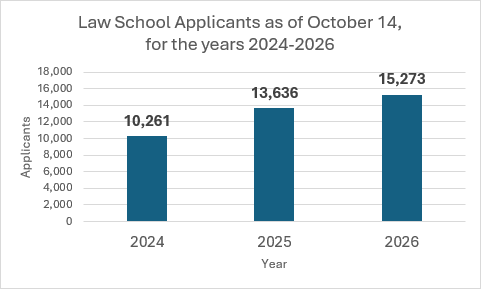
This year’s 12 percent increase is on top of a 33 percent increase at this time last year, which was on top of a 26 percent increase at this point the year before. So, while the rate of increase is slowing as the total numbers get larger, the actual number of early applicants is higher than it’s ever been.
As of October 14, 15,273 individuals have applied for admission in the 2026-2027 cycle, an increase of 12.0 percent compared to the same date last year, and 48.8 percent more than two years ago.
Several other indicators also point to strong continued interest in law school. Through the first four tests of the 2026-2027 LSAT testing cycle, aggregate registrations are up 3 percent compared to the same period last year, and up 20 percent compared to two years ago. And first-time test takers are up slightly from the high levels we saw last year.
The applicant pool continues to reflect a robust cross-section of society. Women applicants are up 12 percent, men applicants are up 12 percent, gender-diverse applicants are up 3 percent, and the number of applicants who chose not to identify, while small, is up 19 percent. Applicants of color are up 11 percent, and first-generation college graduate applicants are up 11 percent.
Factors That May Be Driving Continued Growth in Applicants
There are several potential reasons why the number of early applicants is high at this early stage of the cycle.
The past several admission cycles have been extremely competitive due to the volume of applicants. We often see a wave of early applicants in years following more competitive cycles. The number and proportion of reapplicants from previous cycles is higher this year than in any of the past five years. We will continue to monitor these types of factors as the 2026 cycle develops.
More broadly, there are several reasons why many people are interested in legal education right now. LSAC surveys of test takers and applicants find that the top reasons people give for wanting to go to law school are to be helpful to others, to advocate for social justice, and to gain valuable skills and economic security.
Many individuals cite the current political environment as a factor that has motivated them to go to law school, in order to advocate for issues or communities they care about. The uncertain economic climate and the potential impact of AI and other trends on future employment is another factor – some people view law and advocacy as a field that will continue to grow. Every applicant has their own set of reasons.
We encourage people to visit the volume summary data on LSAC.org regularly, to see how this application cycle evolves over time. These early numbers will shift over time, but it is clear that there continues to be strong interest in law school among a wide range of prospective students.