About the Test Format and Testing Interface

Due to scheduled maintenance, some services on LSAC.org, including access to JD Services, will be offline starting at 9 p.m. ET on Tuesday, October 13 until approximately 1 a.m. ET on Wednesday, October 14. Most services on LawHub and Unite will be available during the maintenance window. We thank you for your understanding.
The information on this page is designed to help candidates determine their accommodation needs as applicable to the specific format and delivery of each part of the LSAT®. We encourage candidates to review this information to learn about the specifications of the test, including the test interface’s built-in accessibility features and the types of assistive technology that are compatible with the LSAT and LSAT Argumentative WritingSM.
The LSAT is designed to measure skills that are considered essential for success in law school: the reading and comprehension of complex texts with accuracy and insight, the organization and management of information and the ability to draw reasonable inferences from it, the ability to think critically, and the analysis and evaluation of the reasoning and arguments of others. The standard LSAT is composed of four 35-minute multiple-choice sections (one Reading Comprehension, two Logical Reasoning, and one unscored variable section).
The three scored sections of the LSAT will include two sections of Logical Reasoning questions and one section of Reading Comprehension questions. The LSAT will continue to include a fourth, unscored variable section, which enables LSAC to validate new test questions for future use. The LSAT will continue to include a 10-minute intermission between the second and third sections for all test takers.
Starting with the August 2026 LSAT, the multiple-choice portion of the LSAT is moving toward in-center testing for almost all test takers, with limited exceptions. Remote testing exceptions that will be considered for 2026-2027 LSAT administrations include but are not limited to candidates with certain disability-related accommodations that require a separate room in a test center. As a result, test takers who have been approved for certain accommodations may need to take the test in a certain modality unless they have a permission to test in a different modality. Disability-related requests to test in a test center or remote modality must be appropriately supported and made by the accommodation request deadline for the applicable LSAT administration.
Alternative formats (e.g., paper-and-pencil, braille) are available as testing accommodations. Approved paper-based format tests (including braille) for the LSAT multiple-choice sections will be delivered in Prometric test centers and are only available to candidates located within the United States (including Puerto Rico, U.S. Virgin Islands, American Samoa, Guam, and the Northern Mariana Islands) and Canada.
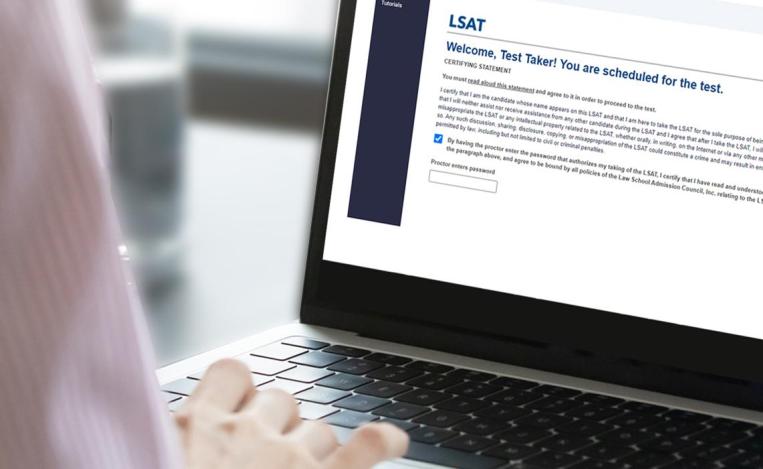
Absent an approved accommodation for an alternative format, the LSAT is delivered on the computer through the LawHub interface.
We encourage test takers to familiarize themselves with the list of personal items that are permissible during the LSAT without prior approval from LSAC.
For information about the LSAT’s built-in accessibility features and the types of assistive technology that are compatible with the LSAT, please review Accessibility, Assistive Technology, and the LSAT below.
LSAT Argumentative Writing is an essential part of the LSAT but is administered separately from the multiple-choice sections of the test. LSAT Argumentative Writing is an unscored writing sample that is delivered exclusively online using secure remote-proctoring software that is installed on the candidate’s own computer. The structure of LSAT Argumentative Writing is specifically designed to elicit the kind of argumentative writing that candidates will be expected to produce in law school. Although LSAT Argumentative Writing is not scored, each test taker must have a completed and approved writing sample on file for their LSAT score to be released.
Test takers will be presented with a debatable issue (identified in the Key Question), along with different perspectives that provide additional context for the issue by introducing various claims that have been made within that debate. Test takers will then write an argumentative essay in which they take a position within the ongoing conversation, while addressing at least one of the arguments and ideas presented in the other perspectives.
Before writing the essay, test takers will have 15 minutes for prewriting analysis. This time is designed for test takers to read and analyze the perspectives in the conversation and reflect on the questions to help generate ideas for their essay. All test takers will have the option to move past the prewriting analysis after five (5) minutes of time has expired. Test takers will then have 35 minutes to write their essay.
LSAT Argumentative Writing must be taken remotely and will continue to be administered separately from the multiple-choice sections of the test. Although alternate formats (e.g., paper-and-pencil, braille) are available as testing accommodations, all LSAT Argumentative Writing test takers (including those approved for a paper-based format) will need to use their computer and webcam throughout the testing session for remote proctoring and to implement the timing for each part of the test.
For more information about the writing portion of the LSAT, please review the LSAT Argumentative Writing page and LSAT Argumentative Writing FAQs.
The LSAT test-delivery software includes several built-in, user-adjustable tools, including a feature to increase text size incrementally and a line-spacing function. The LawHub interface also provides several options for candidates to select a color scheme.
Assistive technology programs, such as keyboard-controlled screen reading software, screen magnification programs, or speech recognition software, are available to test takers as an approved accommodation.
The following programs are available in Prometric test centers:
Candidates who wish to use assistive technology must submit an accommodation request through JD Services by the registration deadline associated with their test date. If you require a program other than those listed above, please indicate your request in Step 2 of the Candidate Form.
International test takers can only use assistive technology programs in a Prometric test center.
The LSAT Argumentative Writing interface offers many common word-processing functions, including text enlargement; line spacing; the ability to cut, copy, and paste text within candidates’ essays; and a built-in spell check feature that identifies misspelled words and underlines them. Test takers can then access a context menu of suggested spelling options from each misspelled word. The LSAT Argumentative Writing test-delivery software also includes a built-in, digital “scratch paper” section where test takers are able to type notes, instead of writing them on a physical piece of scratch paper. We encourage candidates to familiarize themselves with the built-in features of the computer-based LSAT by utilizing the free Official LSAT Prep® practice tests available through LawHub®.
Assistive technology programs to make web content accessible, such as keyboard-controlled screen reading software, screen magnification programs, or speech recognition software are available to test takers as an approved accommodation. Candidates who wish to use assistive technology must submit an accommodation request through JD Services by the registration deadline associated with their test date.
LSAT Argumentative Writing is administered remotely for all test takers.
We encourage you to familiarize yourself with the built-in features of the computer-based LSAT by utilizing the free Official LSAT Prep® practice tests available through LawHub® . To get familiar with LSAT Argumentative Writing, candidates are encouraged to use their own equipment to explore LawHub’s free LSAT Argumentative Writing practice prompt. The practice test software for both the LSAT and LSAT Argumentative Writing is designed to enable candidates to become familiar with the test interface and experience.
If you use screen reader programs or other accessibility software, please be sure to use your programs to explore the practice test tools mentioned above prior to your test date. If you have any questions about the accessibility of LSAC’s products, please contact accessibility@LSAC.org.
For a non-exhaustive list of testing accommodations that may be available, please visit Accommodations That May Be Available on the LSAT.